
Industrial Real Estate in Dubai: A Technical Investment Analysis for Serious Investors (2026 Outlook)
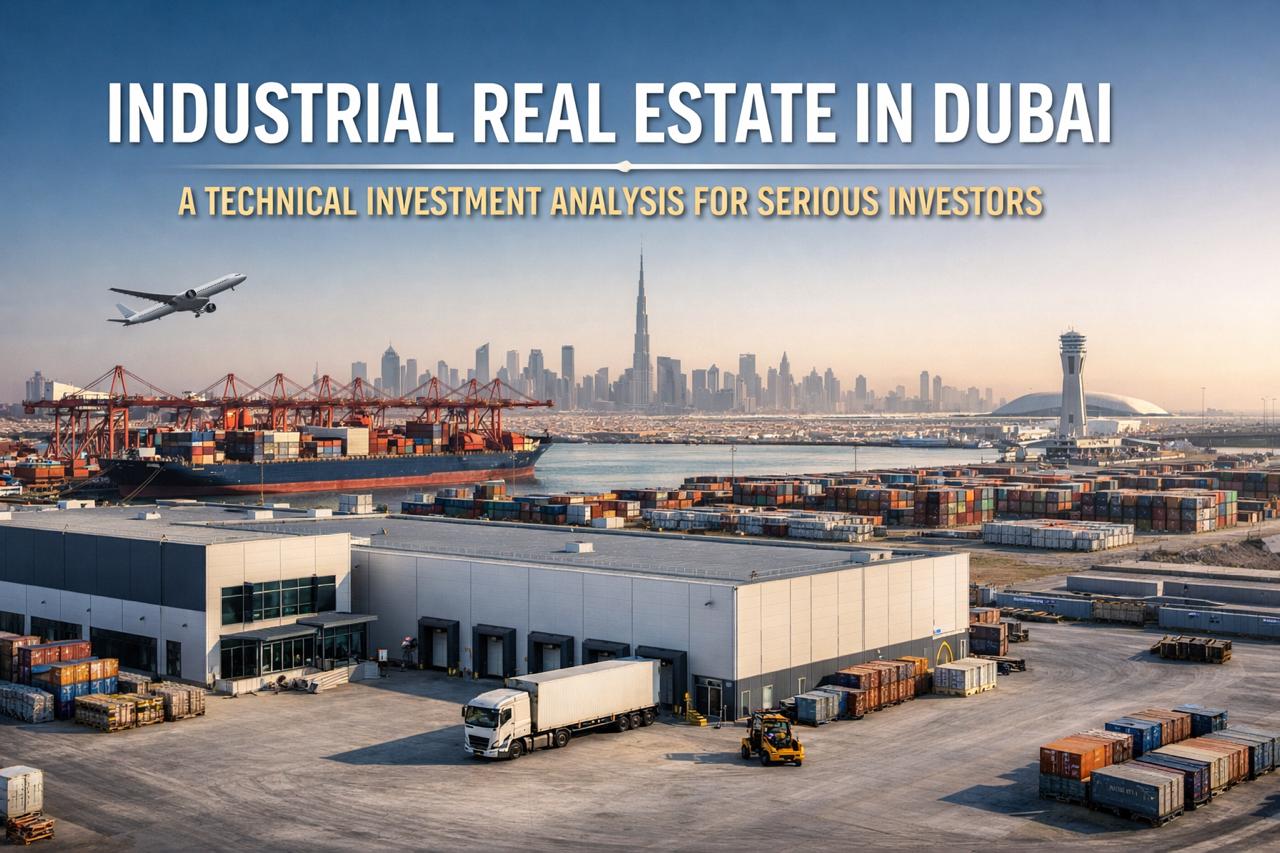
Dubai's industrial real estate sector has transitioned from a secondary asset class to a core institutional investment segment. While residential markets remain cyclical and sentiment-driven, industrial assets are supported by structural demand drivers: logistics expansion, trade growth, supply-chain diversification, and regional manufacturing strategy.
For disciplined investors, industrial property offers something rare:
- Predictable income + measurable upside + strong exit liquidity
This article provides a technical breakdown of how to evaluate industrial opportunities in Dubai in 2026.
1. Market Structure & Strategic Corridors
The primary industrial and logistics corridors include:
- Dubai Investment Park (DIP)
- Dubai Industrial City (DIC)
- Jebel Ali Free Zone (JAFZA)
- Al Layan Industrial Area
Each submarket operates with different pricing tiers, lease structures, and tenant profiles.
For yield-focused investors, secondary corridors often provide superior IRR if structured correctly.
2. Rental Benchmarking & Yield Metrics
Industrial warehouse rents in Dubai vary based on:
- Clear height (8m vs 12m)
- Insulation quality
- Power load capacity
- Yard depth and truck maneuverability
- Proximity to highways
Typical 2026 Benchmarks
| Asset Type | Rent (AED psf) |
|---|---|
| Standard Warehouse | AED 45 - 55 |
| Modern Grade A Warehouse | AED 55 - 70 |
| Prime Logistics Assets | Higher (specification dependent) |
Yield Framework
Gross Yield = Annual Rent ÷ Total Acquisition Cost
Core areas: 7.5% - 9%
Secondary growth corridors: 8.5% - 11%
Well-structured developments in emerging zones can outperform stabilized core assets.
3. Development Feasibility Model (Technical Example)
Let's model a typical project:
| Parameter | Value |
|---|---|
| Plot Size | 100,000 sqft |
| Build-up Ratio | 70% |
| Total BUA | 70,000 sqft |
| Construction Cost | AED 180 - 210 psf |
| Professional & Authority Fees | 12 - 15% |
| Infrastructure & Contingency | 5 - 8% |
Estimated Development Cost (illustrative range):
AED 15M - 18M depending on specification and land cost.
If leased at AED 60 psf:
Annual Gross Income = 70,000 × 60 = AED 4.2M
Gross Yield (if total cost 16M) ≈ 26% on build cost
Overall yield depends on land acquisition price.
This is why land entry price discipline is critical.
4. Tenant Risk & Covenant Strength
Industrial assets are only as strong as the tenant profile.
Key Tenant Categories
- 3PL logistics operators
- E-commerce distribution
- Automotive supply chains
- Construction material distributors
- Light manufacturing
Risk Mitigation Strategy
Investors should underwrite tenant covenant quality, not just rental rate.
5. Capital Appreciation Dynamics
Unlike residential assets driven by sentiment, industrial appreciation is driven by:
- Infrastructure expansion
- Road connectivity upgrades
- Supply shortage
- Manufacturing policy support
Emerging industrial corridors historically appreciate 6-9% annually during expansion cycles.
As Dubai continues strengthening logistics infrastructure near Jebel Ali Port and Al Maktoum International Airport, industrial land becomes a strategic asset, not just income-producing property.
6. Risk Analysis
Professional investors must evaluate:
- Construction cost inflation
- Over-supply cycles
- Regulatory changes
- Global trade slowdown
- Liquidity timing on exit
However, compared to office and retail, industrial remains one of the most resilient asset classes in Dubai.
7. Exit Strategies
Industrial assets provide multiple exit routes:
A stabilized, fully leased warehouse with 3-5 year contracts attracts strong buyer demand.
Final Investment Perspective
Industrial real estate in Dubai is no longer an opportunistic play. It is a strategic asset class.
For disciplined investors:
- Control your land entry price
- Build modern specifications
- Secure long-term tenants
- Plan exit before acquisition
The industrial sector rewards technical structuring, not speculation.
Connect with Dr. Fouad Ouakili
International Real Estate Consultant & Industrial Project Advisor
Dubai, UAE